
Biography
I’m working at Pasteur Labs as a Simulation Intelligence Scientist, where I research, design and implement production-ready ML surrogate models for physical simulations, with a focus on graph and point-cloud learning, scalable data pipelines, and geometry-aware generalization across complex CAD/CAE systems.
I received my PhD in Mechanical Engineering from the Mechanical and Aerospace Engineering Department at NC State University in July 2024, specializing in machine-learning surrogate modeling and Computational Fluid Dynamics (CFD).
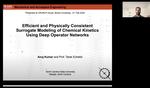
At Argonne National Laboratory, I worked on the development of a highly accurate, robust, and physically compliant Neural ODE model to learn stiff chemical kinetics.
Previously, I worked on acceleration of turbulent combustion simulations through reduced-order models in collaboration with Sandia National Laboratories. Additionally, I worked on dynamical-system analysis of turbulent boundary layers through resolvent analysis.
In addition to research, I enjoy playing badminton, cooking, and going on road trips.
Download my CV.
- Scientific Machine Learning
- Surrogate Modeling
- Reduced Order Modeling
- Computational Fluid Dynamics
- High Performance Computing
- Turbulence
- Chemical Kinetics
-
PhD in Mechanical Engineering (Minor in Applied Mathematics), 2019-2024
North Carolina State University
-
MS in Mechanical Engineering, (en-route to PhD)
North Carolina State University
-
Bachelor of Technology in Mechanical Engineering, 2016
Indian Institute of Technology Kanpur
Skills
Research Experience
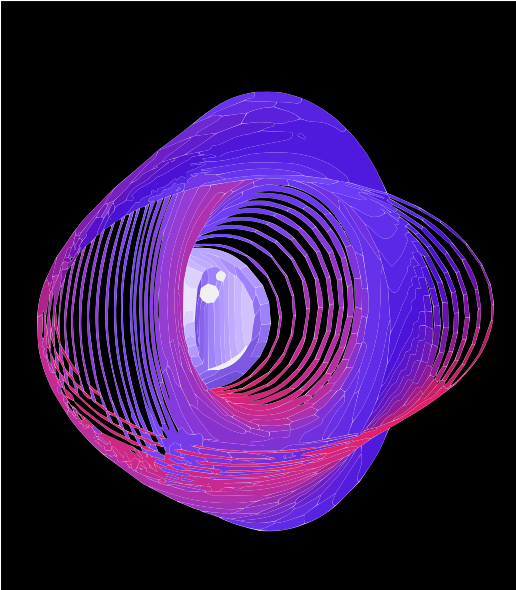
As a Simulation Intelligence Scientist, I
- Research, Design and implement production-ready graph and point-cloud surrogate neural operator models in JAX and PyTorch, along with robust data pipelines and preprocessing workflows to support reliable training, evaluation, and deployment.
- Investigate effective geometry representation in point clouds and global-interaction mechanisms in graph neural networks, including approaches to incorporate physical symmetries for steady-state surrogate modeling and improved generalization across diverse CAD geometries.
- Develop subsampling and subgraph/partitioning strategies to scale learning and inference to large CAE datasets, reducing memory bottlenecks and enabling efficient processing of high-resolution simulations.
- Collaborate with cross-functional engineering teams and external research partners to validate methods, translate research into practical capabilities, and align Simulation Intelligence efforts with real-world constraints and product needs.

React-DeepONet: Developed a Deep Operator Network (DeepONet) based surrogate model for Stiff Chemical Kinetics.
- Employed a novel training mechanism and modified DeepONet architecture to learn the integration operator corresponding to large reaction systems.
- Added Param Net, Shift Net and learned Chemical Kinetics in latent space from Autoencoder for efficient training and robust predictions.
- Modeled and trained the modified DeepONet in JAX framework utilizing Just In Time compilation and Auto-Vectorization.
- Achieved stable and accurate long-time predictions with a huge Speed-Up of three orders (1000)
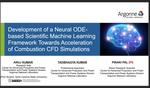
ChemNODE: Worked on development of efficient and robust Neural ODE models to learn stiff chemical kinetics.
- Implemented second-order optimizer (Levenberg–Marquardt) for efficient model training and robust predictions.
- Deployed Physics-Informed training for physically compliant and robust predictions.
- Latent Space Kinetics Identification through Neural ODE for large and complex fuels.
Reduced- Order Modeling of Turbulent Combustion (In collaboration with Sandia National Laboratories).
- Low- dimensional manifold is identified in form of Principal Components (PC) and these modes are evolved in time instead of thermochemical species in a direct numerical simulation.
- Chemical source terms and transport coefficients for the PC modes are mapped through high-fidelity Neural Networks.
- Achieved Speed-Up of two orders (80) with great accuracy on a laboratory-scale Bunsen Flame.
Input-Output analysis of Turbulent boundaries through Resolvent Analysis.
- Performed Resolvent analysis on the time-averaged turbulent mean flows.
- Identified the most responsive inputs and most receptive outputs of the dynamical system.
- Application to Shock- wave turbulent Boundary Layer Interaction (SBLI): Captured low-frequency unsteadiness and identified the most-energetic turbulent eddies after flow separation.
- Application to Compressible Turbulent Boundary layer: Obtained the dominant coherent structures in the boundary layer and confirmed their adherence to the attached eddy hypothesis.

Analysis of Thermal Buckling in a Jet Engine Compressor Disk.
- Investigated critical temperature for various modes using pre-existing literature on buckling of a solid disk.
- Modeled a solid disk and obtained the solution using eigenbuckling analysis on Ansys, matched with theoretical results.
- Predicted factor of safety for the Jet engine compressor disk using solutions procedure as used for the solid disk.

Computational analysis of suppression of the vortex shedding around a square cylinder.
- Numerically investigated flow around a square cylinder; discretizing Navier-Stokes equation by Marker and Cell Method.
- Identified suppression region and obtained the drag coefficient for various sizes of control cylinders and Reynolds numbers.
Publications



Invited Talks and Conference Presentations

Contact
- anujv12@gmail.com
- 984 255 3285
- San Francisco, CA 94158
- Book an appointment